We research, compare, and evaluate every product we recommend, and only describe a pick as directly tested when that is specifically documented. As an Amazon Associate I earn from qualifying purchases. When you buy through our links we may earn a commission -- at no extra cost to you. Full disclosure.
Standard home organization advice -- label everything, have a place for everything, put things back immediately -- fails for ADHD brains for a specific reason: it requires consistent executive function to maintain. The system works fine on the day you set it up. It collapses over the following two weeks as the mental overhead of maintenance outpaces your available bandwidth.
ADHD-friendly organization is designed differently. It minimizes the number of steps required to put things away, eliminates lids and doors wherever possible, uses visual cues instead of memory, and builds systems that degrade gracefully rather than failing completely when maintenance lapses. This guide covers the specific products and setups that work with ADHD executive function rather than assuming it is unlimited.
This is practical home-setup guidance, not medical advice. Use it as a way to reduce friction in your space, and work with a qualified clinician or coach for diagnosis, treatment, or personal support.
The 4 Principles of ADHD-Friendly Storage
Principle 1: Reduce Steps to Zero
Every step between "done using this" and "put away" is a failure point. A container with a lid requires picking up the lid, placing the object, replacing the lid -- three steps. An open bin requires dropping the object in -- one step. For items used frequently, eliminate all steps between use and storage. Open bins, open shelves, and hooks always beat closed containers and drawers for daily-use items.
Principle 2: Out of Sight = Out of Mind
ADHD brains frequently rely on visual cues to remember objects exist. Items stored inside opaque containers, behind closed cabinet doors, or in drawers are effectively invisible -- and invisible items do not get used, returned, or maintained. Use clear containers, open shelves, and visible storage for everything you need to remember exists. Reserve closed storage for items that cause visual clutter but do not need frequent access.
Principle 3: Design for Degradation
An ADHD organization system should tolerate a week of no maintenance without collapsing. Design for the bad week, not the good week. This means: large catchall zones for when items do not make it back to their specific location, generous storage capacity (never fill a system to 100%), and containers that can hold overflow without the whole system failing. A desk tray that holds 20 items when full but functions at 5 items when empty is better than a perfectly divided organizer that becomes useless when one category overflows its section.
Principle 4: Make the Right Choice Easy
The correct storage location should always be easier to reach than any other location. If the correct place for mail is a tray on the desk but the desk is far from the door, mail piles at the door -- not at the desk. Relocate storage to where the item is actually dropped, not where you think it should logically be stored. Follow your existing habits and build storage around them.
Room-by-Room ADHD Storage Systems
Entry: Stop the Pile at the Door
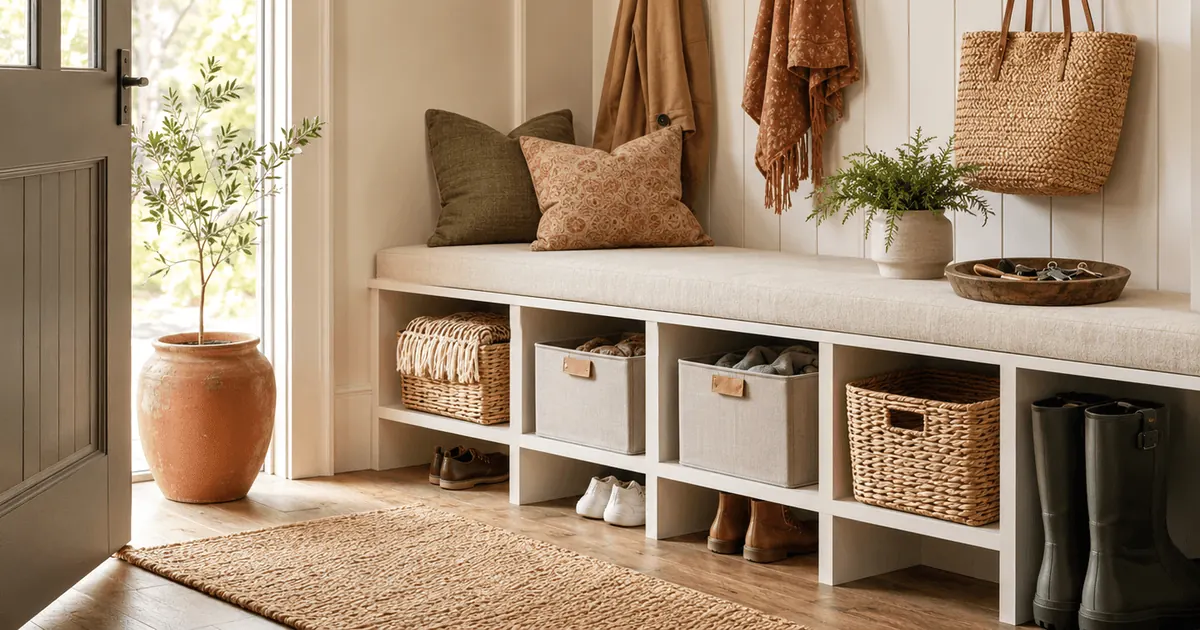
The entry is where ADHD organizational breakdown most visibly occurs: bags dropped on the floor, keys on a random surface, mail on every available horizontal space, shoes everywhere. The fix is not discipline -- it is placing the correct storage exactly where the items are already being dropped.
What works: A wall-mounted hook strip directly beside the door at the height you naturally reach when walking in (not a hook behind the door you have to open to access). A key hook at eye level beside the hook strip. A shallow wall-mounted tray for mail and small items at the same location. A low open-top shoe bin or tray directly inside the door where shoes are already being taken off.
The entire system takes 30 seconds to use because it requires zero detour from your existing entry behavior -- you walk in, hang the bag on the hook you are already passing, drop keys on the hook that is already there, toss mail in the tray that is already open.
Compare Options
Compare Options
Living Room: Contain the Scatter
ADHD living rooms accumulate items from every room in the house because the living room is where most time is spent and items migrate toward where you are. The solution is not removing items from the living room -- it is providing organized containment so the scatter is bounded.
What works: A large storage ottoman as a coffee table that holds blankets, remotes, chargers, and frequently used items in one accessible, closeable container. Open labeled bins on a low shelf for items that belong in other rooms (a "return to bedroom" bin, a "return to kitchen" bin) that you empty once a day rather than making individual trips. A charging station on the side table where devices go to charge instead of scattered across every horizontal surface.
Compare Options
Bedroom: Visual Closet, Accessible Drawer System
ADHD bedroom organization fails on two fronts: clothing does not make it from the floor to the closet, and clean and worn clothing gets mixed. Both failures have the same root cause: the storage system requires too many steps.
For clothing that does not make it to the closet: A dedicated "worn but not dirty" hook or rack is more honest than a closet. Clothes worn once but not ready for laundry have nowhere to go in a standard system -- so they go on the floor. A large hook on the back of the bedroom door or a dedicated clothing rack with one bar for "worn" items gives this category a home and keeps it off the floor.
For the closet itself: Keep it as open as possible. Open shelves instead of folded drawers for frequently worn items -- you can see everything at once. Open bins on the closet floor for categories (gym clothes, loungewear) instead of folded stacks that collapse. Hanging organizers for items that would otherwise pile on the shelf.
For the dresser: Vertical file-folding (KonMari method) in drawers keeps every item visible without digging -- the key ADHD benefit is that you never have to move one thing to find another. Drawer dividers maintain category separation without requiring refolding after laundry.
Compare Options
Compare Options
Kitchen: Clear Containers and Open-Access Everything
ADHD kitchen organization collapses when items go behind closed doors and get forgotten. The pantry cabinet with opaque doors becomes a black hole. The drawer full of random items never gets cleaned out. The fix is visibility.
Pantry: Clear containers for every dry good you use regularly -- flour, pasta, rice, cereal, snacks, coffee. If you can see it, you remember it exists and you use it before it expires. Label the containers with masking tape and a marker (label makers create enough friction that labeling does not happen). Keep frequently used items at eye level and arm reach; reserve high shelves and back sections for backup stock.
Cabinet organization: A lazy Susan in corner cabinets makes inaccessible back sections fully visible and reachable in one spin. Pull-out drawer inserts for pots and pans eliminate the need to unstack everything to find the right lid. Cabinet door organizers for lids, cutting boards, and flat items keep them accessible without a separate storage decision.
Counter policy: Everything used daily stays on the counter. ADHD brains do not reliably put things away and retrieve them from cabinets -- if the coffee maker goes back in the cabinet, coffee stops getting made reliably. Identify your actual daily-use items and give them permanent counter real estate. Organize the counter items with a consistent layout so you always know what is there.
Compare Options
Compare Options
Home Office and Desk: Visible, Single-Layer Organization
ADHD desk systems fail when items go into drawers and disappear. The standard advice of "clear your desk at end of day" is directly counter to how ADHD visual memory works -- a clear desk is a blank slate where nothing can be remembered by sight.
What works instead: A desktop organizer with open compartments that keeps active projects and materials visible. A paper tray system with labeled open trays (Action Required, To File, Reference) rather than a pile or a closed file drawer. A large whiteboard or corkboard for tasks and reminders that are visible during work, not buried in an app. Charging cables permanently routed to their devices -- not wound up and put away, because unwinding and routing cables is enough friction to delay charging until the battery is dead.
Drawer strategy: If you have desk drawers, dedicate one drawer to "active project overflow" -- the things on your desk that need to be moved but are still in use. This single accessible dump zone prevents desk clutter from becoming floor clutter during busy periods.
Compare Options
Compare Options
Bathroom: Put Things Where You Use Them
ADHD bathroom organization works on one principle: items go where you use them, not where they "belong." If you apply skincare at the sink, skincare lives at the sink -- not in a cabinet across the room where it belongs on a shelf. If you take medication in the kitchen with breakfast, the medication lives in the kitchen. Storage location should follow use location, not storage logic.
Counter stays populated: Everything in your daily routine stays out. A countertop organizer tray contains the clutter without requiring items to be put away. Weekly or less-frequent items go under the sink in an expandable organizer. Monthly or backup items go in the highest cabinet.
Compare Options
| Storage Tool |
ADHD-Specific Benefit |
| Clear bins (all sizes) |
Visual contents without opening |
| Open wall hooks everywhere |
Zero-step storage for daily items |
| Large open storage ottoman |
Catchall containment in living spaces |
| Over-door pocket organizers |
Immediate visible access, no door opening |
| Drawer dividers |
Categories maintain without refolding |
| Lazy Susans in cabinets |
Eliminates hidden back-of-cabinet black holes |
| Whiteboard / corkboard |
Physical visual task and reminder system |
| Open desktop organizer |
Active project visibility, no drawer burial |
| Masking tape labels |
Lower labeling friction than label makers |
| Large entry catchall tray |
Bounded landing zone at actual drop points |
What Does NOT Work for ADHD Organization
Complex Labeling Systems
Intricate labeling with color-coding, subcategories, and specific locations requires consistent executive function to maintain. Labels that require a label maker to create add enough friction that bins stay unlabeled. Use masking tape and a marker, keep labels to one word or simple category names, and accept that some bins will go unlabeled -- a bin with contents slightly different from its label is better than an unlabeled pile.
Lids on Everything
Lidded containers require a lid removal step every time you access contents. For daily-use items, this is the difference between using the storage system and not using it. Reserve lids for rarely-accessed items (seasonal storage, backup supplies) and use open bins for everything accessed more than twice a week.
Matching Set Aesthetics Over Function
Organizing systems sold as matching sets look cohesive but force all items into the same container type regardless of what actually works. A random assortment of clear containers in the right sizes beats a beautiful matching set where the sizes do not fit the items. Function is the priority; aesthetics come after the system is working.
Relying on Memory-Based Systems
"Put it back where it belongs" requires remembering where that is. For ADHD brains, memory-based storage systems fail under cognitive load -- exactly when you most need them to work. Redundant visual cues (labels, clear containers, visible open shelving) replace the memory requirement and make the system accessible regardless of current executive function state.
Frequently Asked Questions
Why does my organization system always fall apart after a few weeks?
Because it was designed for the high-executive-function version of you, not the average version. Systems that require multiple steps to use, require putting items in non-obvious locations, or rely on consistent follow-through degrade during high-stress or low-bandwidth periods. Rebuild the system around your worst-day behavior, not your best-day behavior: fewer steps, more visual cues, larger catchall zones, and more forgiveness built in.
What is the most important ADHD organization change to make first?
Identify the three places in your home where clutter consistently accumulates and put storage there -- at that specific location -- rather than where it "should" go. If bags pile at a chair rather than at the door, add a hook at the chair. If mail piles on the kitchen counter, put a mail tray on the kitchen counter. Work with your actual behavior rather than trying to change it through organization.
How do you maintain an ADHD organization system long-term?
Design for a 10-minute weekly reset rather than daily maintenance. Once a week, do a single lap through the house putting obvious out-of-place items in their correct location. This is realistic. Daily 5-minute resets are not -- they require consistent motivation that ADHD executive function cannot reliably supply. The system should tolerate 6 days of normal entropy before the weekly reset brings it back.
Is it better to have fewer storage locations or more?
Fewer categories with larger containers beats more categories with smaller containers for ADHD systems. One large "desk supplies" bin is better than five individual containers for pens, paper clips, sticky notes, scissors, and tape -- the single-bin system degrades more gracefully and requires fewer decisions about where an item belongs.
The Bottom Line
ADHD organization is not about trying harder or being more disciplined -- it is about designing a system that does not require discipline to function. Open bins where you actually drop things, hooks where you actually hang things, clear containers where you actually need to see things, and catchall zones large enough to contain the bad week.
The total investment for a complete ADHD-friendly home organization overhaul -- clear bins for pantry and closets, hooks for every landing zone, a storage ottoman for the living room, drawer dividers for clothing, and a desktop organizer -- runs $100 to $200. The return is a home that stays organized not because you maintain it perfectly, but because it was built to work even when you do not.